Live Simultaneous Interpretation vs AI Translation: A Faster Way to Run Multilingual Meetings
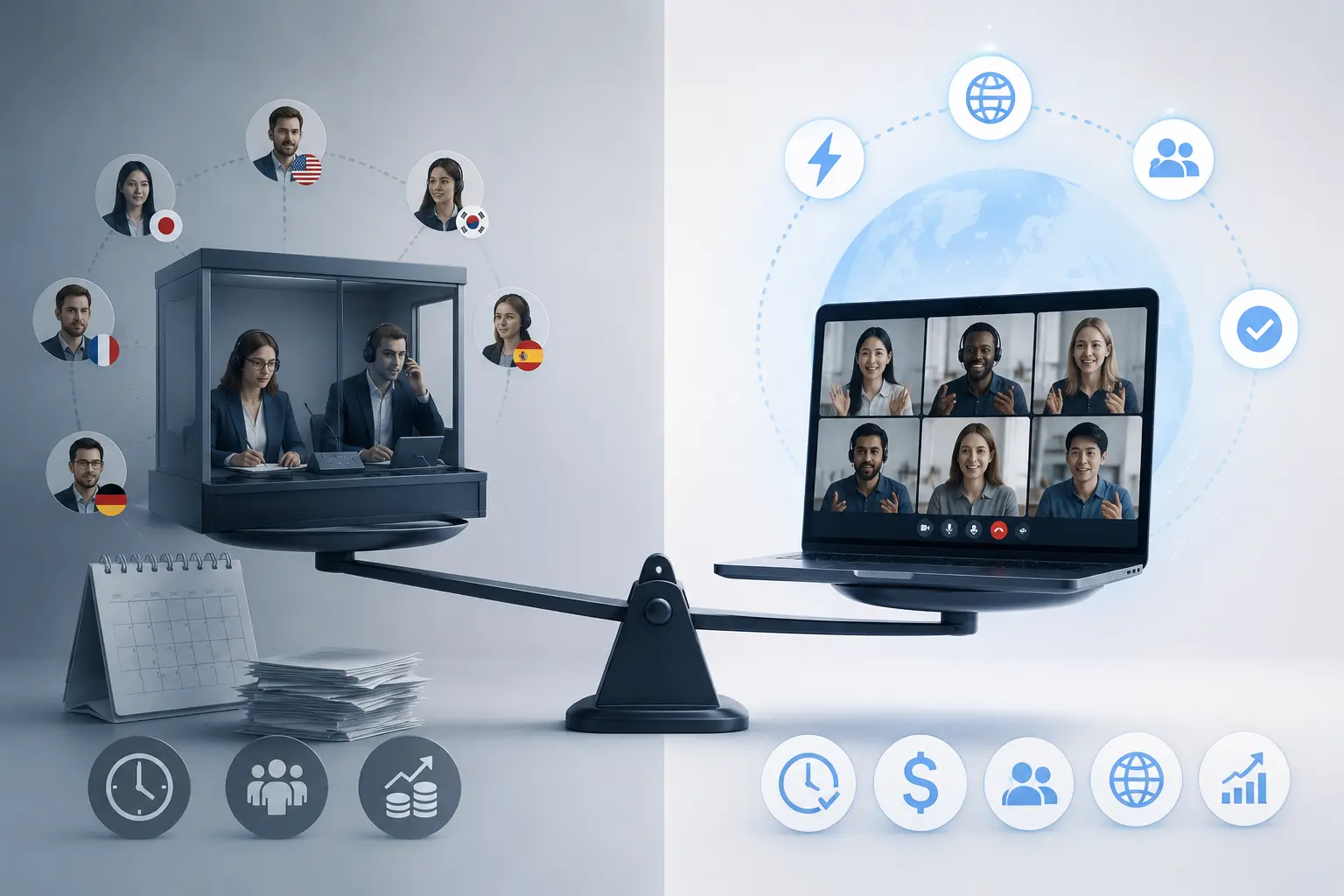
When people who speak different languages need to communicate in real time, the traditional solution has been simple: hire an interpreter.
For an important one-to-one meeting, this can work well. But as soon as a meeting involves several languages, multiple participants, or frequent international calls, traditional simultaneous interpretation becomes much more complicated.
You need to find available interpreters, coordinate schedules, arrange the technical setup, and often hire more than one interpreter for a multilingual conference.
Voicli offers a different approach: real-time voice translation built directly into online meetings.
Participants speak naturally in their own languages, while Voicli translates the conversation in real time for the other people in the meeting.
Instead of organizing interpretation around the meeting, translation becomes part of the meeting itself.
What Is Live Simultaneous Interpretation?
Simultaneous interpretation means translating speech while the speaker is talking, rather than waiting until the speaker finishes.
It is commonly used for:
international conferences
business negotiations
interviews
diplomatic meetings
webinars
multinational company meetings
training sessions
events with international audiences
Traditional simultaneous interpretation normally requires professional interpreters who listen to the speaker and translate the conversation into another language.
For a meeting between two languages, this can be relatively straightforward.
For multilingual meetings, however, the complexity increases quickly.
Imagine a conference with participants speaking English, Japanese, Korean, Spanish, French, and Ukrainian.
Providing professional human interpretation for all of these languages can require several interpreters, additional coordination, and significantly higher costs.
AI-powered real-time translation changes this model.
Voicli vs Traditional Human Interpreters
1. No Need to Find an Interpreter Before Every Meeting
One of the biggest limitations of human interpretation is availability.
Before the meeting can happen, someone needs to:
Find an interpreter for the required language.
Check their availability.
Agree on the price.
Send meeting information.
Coordinate the schedule.
Make sure the interpreter can join the platform being used.
For planned conferences, this may be manageable.
For a spontaneous business call, sales conversation, interview, or urgent discussion, it can become a serious obstacle.
With Voicli, there is no separate interpreter to schedule.
You create the meeting, invite participants, select the languages you need, and start communicating.
This makes real-time voice translation available on demand rather than something that has to be organized separately.
2. One Meeting Can Include Multiple Languages
This is where the difference becomes much larger.
Consider an international meeting with 50 participants speaking six different languages.
With traditional interpretation, supporting every language may require several professional interpreters and potentially additional technical infrastructure.
Voicli approaches the problem differently.
Each participant can speak in their own language and receive translated speech according to their selected language.
That means the same meeting could include people speaking:
English → Japanese → Korean → Ukrainian → Spanish → French
without needing a separate human interpreter sitting in the meeting for every language.
For multinational teams, international conferences, recruiting, education, and global sales, this can dramatically simplify multilingual communication.
3. Lower Cost Than Traditional Simultaneous Interpretation
Professional interpreters provide valuable expertise, especially in situations requiring exceptional linguistic precision, legal knowledge, cultural interpretation, or specialized terminology.
But professional simultaneous interpretation can also be expensive.
The cost increases further when:
several languages are required
multiple interpreters are needed
the meeting lasts several hours
meetings happen frequently
interpreters need to work in shifts
specialized interpreters are required
This makes traditional interpretation difficult to justify for everyday business communication.
Voicli uses AI-powered voice translation instead.
There is no hourly human interpreter fee for every language added to the conversation.
For companies running dozens or hundreds of international meetings, the economics can therefore be fundamentally different.
Instead of deciding “Is this meeting important enough to pay for an interpreter?”, teams can make multilingual communication part of their normal workflow.
4. Translation Is Available Immediately
International communication does not always happen according to schedule.
A customer may request a call today.
A supplier may need to discuss an urgent issue.
A candidate may be available for an interview in an hour.
A new partner may suddenly join a meeting.
With human interpretation, these situations create another problem:
Can you find the right interpreter quickly enough?
With an AI interpreter integrated into the meeting platform, there is no need to wait for someone else to become available.
The translation system is already there.
This makes Voicli especially useful for companies where multilingual communication happens frequently or unexpectedly.
5. One Platform Instead of a Meeting Plus Interpretation Services
Traditional multilingual meetings can involve several separate components:
video conferencing, interpreters, scheduling, language coordination, audio channels, and sometimes additional interpretation software.
Voicli combines video communication and live voice translation in one environment.
Participants do not need to organize a separate interpretation team before every conversation.
They join the meeting and communicate.
The technology handles the translation layer.
6. More Languages Don't Have to Mean More People
This is one of the biggest scalability advantages of AI interpretation.
With traditional interpretation, adding another language can mean adding another interpreter or interpretation pair.
More languages → more coordination → more people → higher costs.
With Voicli, adding another supported language does not mean finding another person who happens to be available at exactly the same time.
This makes multilingual meetings much easier to scale.
A company can move from a conversation involving two languages to a larger international conference without building an entire interpretation team around the call.
7. Participants Can Speak Their Native Language
Many international meetings default to English simply because it is the only language everyone understands to some degree.
But understanding English is not the same as communicating naturally in English.
A person may understand a question perfectly but struggle to:
explain a complex idea
negotiate confidently
describe technical details
respond quickly
express nuance
participate naturally in a fast conversation
This can be particularly important when neither participant is a native English speaker.
Instead of forcing both sides to communicate through a shared second language, Voicli allows participants to speak their preferred languages.
A Korean participant can speak Korean.
A Japanese participant can speak Japanese.
A Ukrainian participant can speak Ukrainian.
The goal is simple: people should focus on the conversation, not on translating sentences in their heads.
8. Faster International Communication
Traditional interpretation introduces organizational overhead before the conversation even begins.
AI-powered interpretation removes much of that preparation.
There is no need to spend time searching for interpreters for routine calls, checking schedules, negotiating availability, or coordinating several language professionals.
For businesses operating internationally, those saved hours accumulate.
The result is not simply faster translation.
It is a faster process for arranging international communication in the first place.
Human Interpreter or AI Interpreter: Which Should You Choose?
AI translation is not intended to eliminate professional interpreters from every situation.
There are still situations where a skilled human interpreter may be the better choice, including highly sensitive legal proceedings, diplomatic negotiations, certain medical conversations, or events where extremely precise interpretation and cultural nuance are critical.
But most international communication does not happen in a courtroom or at a diplomatic summit.
Companies have:
sales calls
candidate interviews
customer meetings
internal discussions
product demonstrations
supplier conversations
training sessions
international team meetings
Hiring professional interpreters for every one of these conversations is often impractical.
This is where real-time AI voice translation can provide the greatest value.
The Future of Multilingual Video Meetings
For decades, international meetings have largely followed two models:
Everyone speaks one common language — usually English — or someone interprets the conversation.
Real-time AI translation introduces a third option.
Everyone can speak their own language.
Instead of requiring participants to adapt to the language of the meeting, the meeting can adapt to its participants.
That changes what multilingual communication can look like.
A company in Korea can speak naturally with a customer in France.
A recruiter in Japan can interview an international candidate.
A Ukrainian founder can negotiate with a Japanese partner.
A multinational team can bring several languages into the same conference.
And they can do it without organizing a separate team of interpreters for every meeting.
Voicli: Real-Time Voice Translation Built for Meetings
Voicli is designed for video meetings where participants don't share the same native language.
Rather than adding translation before or after the conversation, Voicli provides live voice translation while the meeting is happening.
The key advantages are straightforward:
Lower cost than hiring multiple interpreters for frequent multilingual meetings
Multiple languages in one conference
No interpreter scheduling
Immediate availability
Faster meeting setup
No need to hire additional interpreters as every new language is introduced
Participants can speak their preferred language
Suitable for recurring international communication
Voice translation, subtitles, and video meetings in one platform
The result is a different approach to international communication:
Don't find a common language. Let everyone speak their own.
For companies working across countries, languages, and time zones, real-time voice translation can turn multilingual communication from a logistical problem into a normal part of every meeting.
Try Real-Time Multilingual Meetings with Voicli
Experience a meeting where participants can speak different languages and still communicate in real time.
Start a multilingual meeting with Voicli and speak your own language.