Secure and Fast Video Meetings with Real-Time Voice Translation
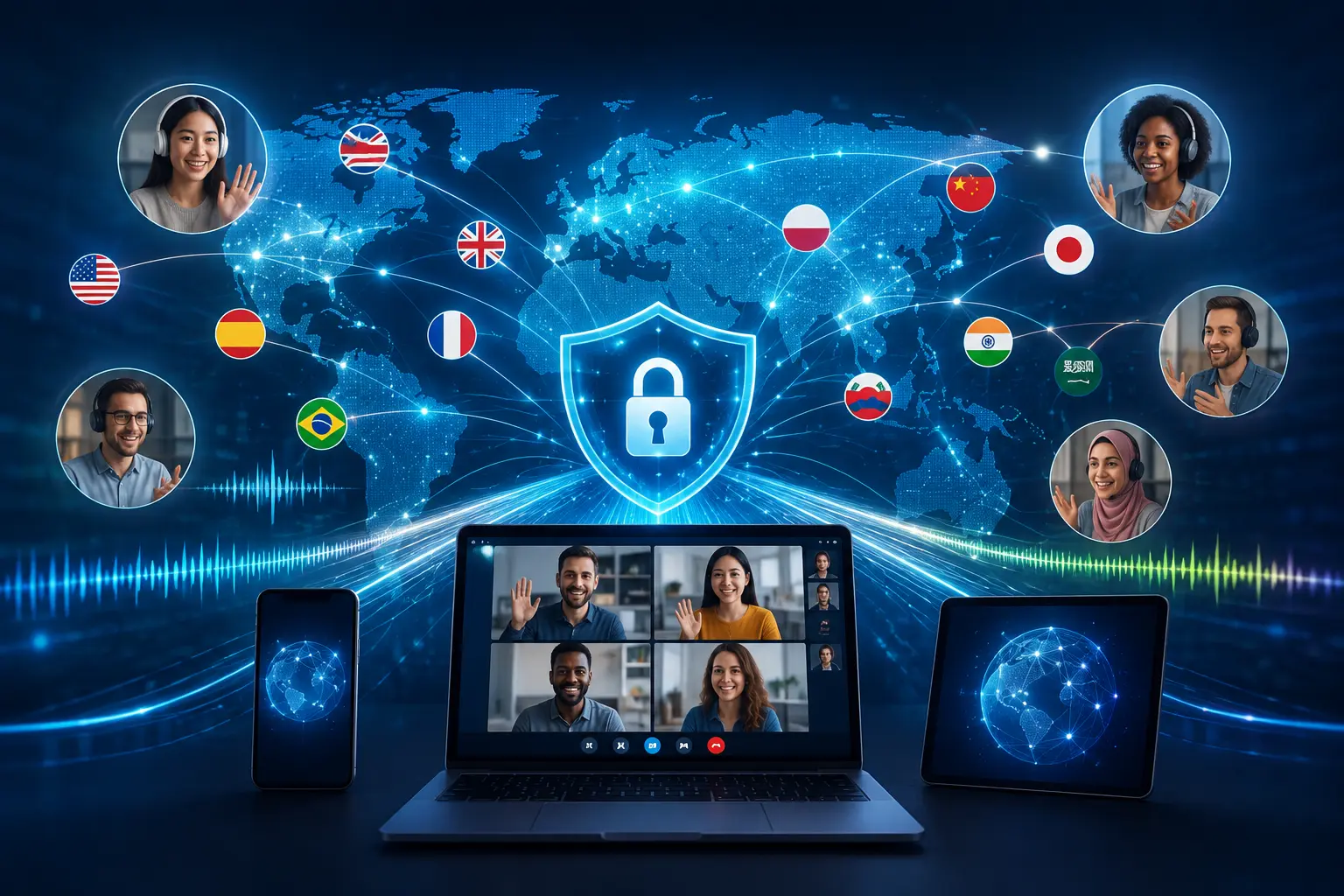
Voicli is a video meeting platform built for multilingual conversations. It combines secure video communication, globally distributed infrastructure, real-time voice translation, multilingual subtitles, and intelligent connection routing in one platform.
Whether participants are joining from Europe, Asia, North America, Africa, the Middle East, or another region, Voicli is designed to provide a fast and stable meeting experience. Each person can speak their preferred language while other participants receive translated speech in the language they understand.
This makes Voicli suitable for global teams, international recruitment, remote education, immigration services, consulting, customer support, healthcare communication, and other situations where language differences can make video meetings difficult.
What Is Voicli?
Voicli is a multilingual video meeting platform with real-time voice translation.
Instead of asking every participant to speak the same language, Voicli allows people to choose their preferred speaking and listening languages. During the meeting, the platform processes speech as it happens and delivers translated audio to participants who need it.
For example:
A participant speaks Ukrainian.
Another participant chooses English.
A third participant chooses French.
Each person can follow the same conversation in their selected language.
The purpose of Voicli is not simply to add translated text below a video. It is to make multilingual video communication feel more natural by combining live audio, translated speech, subtitles, participant controls, and secure meeting infrastructure.
Globally Distributed Infrastructure for Faster Connections
Traditional video platforms may route every participant through the same central location. This can create unnecessary delays when people join from different parts of the world.
Voicli uses globally distributed real-time communication infrastructure. Participants are automatically routed through an appropriate nearby network location instead of being forced to connect through one distant central server.
This architecture helps Voicli provide:
Faster initial connections
Lower network latency
More stable international calls
Better audio and video delivery
Reduced delays between participants
Improved performance for geographically distributed teams
The underlying infrastructure is designed to select resources according to location and network conditions. It can also scale automatically as meeting demand changes. Globally distributed routing and automatic load balancing are established features of the real-time infrastructure used by Voicli.
This is particularly important for meetings involving participants in distant countries.
A meeting between people in Germany, Canada, Japan, and the United Arab Emirates requires a different network strategy from a local call between people in the same city. By using multiple regional locations and intelligent routing, Voicli reduces unnecessary travel time for audio and video data.
Connecting Participants to Nearby Network Locations
When someone joins a Voicli meeting, the platform evaluates how to establish a reliable real-time connection.
Where possible, participants connect through geographically appropriate infrastructure. Regional routing is designed to minimize latency and keep interactions responsive. Similar regional systems currently operate across locations in the United States, Europe, Asia-Pacific, India, the Middle East, Africa, Australia, and Israel.
The closest physical location is not always automatically the fastest route. Internet congestion, provider routing, firewalls, and local network quality can also affect performance. For this reason, Voicli relies on adaptive connection technology rather than simply choosing a location based on a map.
The result is a video meeting platform designed for real-world international communication.
Stable Communication Across Different Networks
Participants do not always join meetings from ideal networks.
Some users connect from:
Office networks with strict firewalls
Home Wi-Fi
Mobile internet
Hotels and airports
Universities
Hospitals
Shared working spaces
Corporate VPNs
Networks where direct media traffic is restricted
Voicli uses modern real-time connection methods that can adapt when the preferred network route is unavailable.
The system first attempts to establish an efficient direct real-time media connection. When restrictive networks block that route, secure relay and fallback mechanisms can be used to maintain connectivity.
These mechanisms include support for secure communication over commonly permitted network channels. This makes it easier to join a Voicli meeting from corporate or institutional environments where ordinary real-time media connections may otherwise be blocked.
No platform can guarantee perfect performance on every internet connection. However, Voicli is built to use multiple connection strategies rather than relying on only one possible route.
Secure Audio and Video Communication
Security is essential for business meetings, interviews, consultations, educational sessions, and private conversations.
Voicli protects audio and video while they are being transmitted between participants and the communication infrastructure. Modern encrypted transport protocols help prevent meeting traffic from being read as ordinary unprotected network data.
This secure communication layer is combined with controlled access to meeting rooms.
Participants cannot simply enter any meeting by guessing its name. Access is managed through authenticated users, meeting permissions, invitations, and secure connection tokens generated for the specific meeting.
Voicli’s security architecture includes:
Encrypted audio and video transmission
Secure participant authentication
Time-limited meeting access credentials
Controlled meeting invitations
Protected API requests
User authorization checks
Rate limiting for sensitive operations
Secure server connections
Permission-based access to meetings
Infrastructure monitoring and error tracking
Security is not treated as one isolated feature. It is applied across authentication, API access, meeting entry, media transmission, and account management.
Private Meeting Access
Every Voicli meeting has controlled participation.
Depending on how the meeting is configured, participants may join through an invitation or send a request to enter. Meeting hosts can manage access and prevent unapproved participants from entering the active conversation.
This is useful for:
Private client consultations
Recruitment interviews
Legal discussions
Medical or support conversations
Internal team meetings
Paid consultations
Parent-teacher meetings
Immigration interviews
Confidential business calls
Voicli also separates meeting access from translation preferences. A participant’s selected language does not give them additional permissions within the meeting.
Real-Time Voice Translation
The central feature of Voicli is real-time voice translation.
Traditional translation workflows often require several separate steps:
Record the speaker.
Wait until the person finishes.
Convert the recording into text.
Translate the text.
Generate new audio.
Play the translation.
A fully sequential workflow creates long and uncomfortable pauses.
Voicli uses streaming voice processing. Audio can be analyzed while the participant is speaking, allowing translation to begin without waiting for an entire long speech to end.
Modern real-time voice technology can translate and transcribe speech as people speak, enabling lower-latency multilingual experiences than traditional file-based processing.
The exact delay can vary depending on:
Internet connection quality
Length and complexity of the sentence
Speaker speed
Background noise
Selected languages
Pronunciation and accent
The participant’s device
Current processing load
Voicli is designed to keep this delay low enough for interactive meetings rather than offline translation.
Translation That Uses Conversation Context
Word-by-word translation is often inaccurate because individual words can have different meanings in different situations.
For example, the correct translation may depend on:
The previous sentence
The topic of the meeting
Who is speaking
Whether the conversation is formal or informal
Industry terminology
The grammatical structure of the full phrase
Voicli’s translation process can use the surrounding conversation instead of treating every sound as an unrelated fragment.
This helps the platform produce translations that are more useful in real conversations involving questions, explanations, negotiations, interviews, or professional terminology.
However, automated translation can still make mistakes. Participants should verify critical information such as legal terms, medical instructions, payment details, addresses, dates, and contractual obligations.
Natural Turn-Taking
Human conversation is not perfectly organized.
People pause, continue a sentence, correct themselves, ask short questions, and occasionally speak at the same time.
Voicli includes turn-management logic designed specifically for translated group conversations. The system tracks whether someone is speaking, whether translation is being generated, and whether translated audio is currently playing.
This helps reduce situations where:
Original and translated speech become difficult to distinguish
Several translated streams play at the same time
A participant’s next sentence begins before the previous translation finishes
Listeners cannot understand which participant is speaking
Voicli also manages original and translated audio separately. Participants can control how much of the original speaker and translated voice they hear.
Original Audio, Translation, and Subtitles
Different users prefer different ways of following a multilingual conversation.
Some want to hear only the original speaker. Others want translated audio. Some prefer to hear both. In certain situations, subtitles are more convenient than voice translation.
Voicli therefore supports several communication modes:
Original Audio
Participants hear the speaker’s natural voice without translated playback.
This is useful when participants understand the original language or want to hear tone and pronunciation directly.
Original Audio with Voice Translation
Participants can hear translated speech while retaining access to the original audio.
This is useful when they want to understand the meaning while still hearing the actual speaker.
Multilingual Subtitles
Speech can be displayed as translated text during the meeting.
Subtitles are helpful when:
A participant cannot use speakers
Audio quality is temporarily reduced
The user prefers reading
The meeting contains names or technical terms
The participant wants visual support alongside translated speech
These modes allow users to choose the meeting experience that works best for them.
Supported Voicli Languages
Voicli currently provides meeting language options for 20 widely used languages:
Arabic
Chinese
Dutch
English
French
German
Hindi
Indonesian
Italian
Japanese
Korean
Polish
Portuguese
Romanian
Russian
Spanish
Thai
Turkish
Ukrainian
Vietnamese
These languages cover communication needs across Europe, Asia, the Middle East, Africa, North America, and South America.
Examples of translation combinations include:
English to Spanish
English to Chinese
English to German
English to French
English to Ukrainian
English to Arabic
English to Portuguese
English to Japanese
English to Korean
English to Vietnamese
German to English
German to Ukrainian
Spanish to English
Spanish to Portuguese
French to English
French to Arabic
Ukrainian to English
Ukrainian to German
Russian to English
Polish to English
Italian to English
Portuguese to English
Romanian to English
Turkish to English
Hindi to English
Indonesian to English
Thai to English
Vietnamese to English
Chinese to English
Japanese to English
Korean to English
The available combinations are not limited to English as the destination language. Participants can select different supported languages within the same meeting.
Voicli may expand this list as translation quality, voice availability, and platform testing improve.
Multilingual Group Meetings
A multilingual meeting may include more than two languages.
For example:
One participant speaks English.
One speaks Ukrainian.
Two participants choose Spanish.
Another participant chooses French.
Voicli organizes translation delivery according to each participant’s language preference.
Participants who understand the speaker’s original language do not necessarily need an unnecessary translated stream. Users who select the same target language can receive the appropriate translation for their language group.
This architecture reduces duplicate work and makes multilingual group meetings more scalable.
It also means the platform is not limited to simple one-to-one translation. Voicli is designed for group conversations where several language preferences may be active at the same time.
Automatic Scaling
The number of people using a communication platform changes throughout the day.
A static infrastructure configuration can become overloaded during busy periods or waste resources when demand is low.
Voicli relies on infrastructure that supports automatic scaling and load balancing. New sessions can be distributed according to available regional capacity rather than depending on one permanent server.
This gives the platform a foundation for supporting:
Small one-to-one conversations
Team meetings
Recruitment interviews
Group consultations
Online classes
International workshops
Larger organizational meetings
The maximum number of participants available to an individual Voicli customer depends on the customer’s subscription plan.
Designed for International Teams
Global teams often use English as a common business language. However, that does not mean every employee communicates equally confidently in English.
Language differences can affect:
Participation in meetings
Confidence when sharing ideas
Understanding of instructions
Career development
Collaboration between departments
Relationships with international clients
Onboarding of new employees
Team inclusion
Voicli allows team members to participate using a language in which they can express themselves more naturally.
This does not remove the value of learning a shared language. Instead, it provides an additional communication tool for situations where clarity and immediate participation are more important than language proficiency.
Video Meetings for International Recruitment
Recruiters frequently search for candidates in other countries.
A candidate may have the required technical skills but struggle to demonstrate them in a second language. Similarly, a hiring manager may find it difficult to explain the role, company culture, relocation conditions, or employment requirements.
Voicli can support:
International candidate interviews
Cross-border recruitment
Technical interviews
Relocation discussions
Employee onboarding
Meetings between candidates and foreign employers
Communication with overseas recruitment partners
Real-time voice translation helps the recruiter and candidate focus on the conversation rather than repeatedly switching between separate translation tools.
Video Meetings for Immigration and Relocation Services
Immigration consultants and relocation specialists often work with clients from many countries.
Important conversations may involve:
Visa requirements
Application steps
Required documents
Accommodation
Employment
Education
Deadlines
Family relocation
Local registration
Written translation is useful, but many clients also need to speak directly with a consultant.
Voicli provides a way to conduct multilingual video consultations without arranging a human interpreter for every initial conversation.
For official or legally binding discussions, professional interpretation may still be necessary. Voicli can nevertheless make early consultations, document preparation, follow-ups, and general explanations more accessible.
Video Meetings for Education
Schools, universities, language programs, and training providers may need to communicate with students or parents who speak different languages.
Voicli can be used for:
Parent-teacher meetings
International student interviews
Admissions consultations
Online tutoring
Student support
Academic advising
International training
Orientation sessions
Translated audio and subtitles can help participants understand each other while maintaining the personal interaction of a video call.
Video Meetings for International Clients
Consultants, agencies, software companies, designers, and other service providers often lose opportunities because communication is difficult before a project even begins.
Voicli can help during:
Discovery calls
Product demonstrations
Project discussions
Client onboarding
Support sessions
Progress updates
Contract preparation
International sales calls
A business no longer has to exclude every potential client who is uncomfortable speaking its primary language.
No Separate Translation Application Required
Using one application for video, another for transcription, and another for translation makes meetings more complicated.
Participants may need to:
Copy text between windows
Wait for manual translations
Share recordings
Repeatedly ask for clarification
Communicate only through chat
Invite a separate interpreter
Voicli brings video communication and multilingual assistance into the same meeting environment.
Participants can manage their microphone, camera, language, original audio, translated audio, subtitles, and meeting chat from one interface.
Browser-Based Access
Voicli is designed to work through a modern web browser.
Participants do not need to install a large traditional desktop application before every call. They can open the meeting link, sign in or request access, select their language, and join through a supported browser.
Browser-based access is useful for external clients because it reduces onboarding friction.
For the best results, participants should:
Use an updated browser
Allow microphone and camera permissions
Use headphones when possible
Choose a quiet room
Avoid speaking too far from the microphone
Use a stable internet connection
Speak clearly and pause naturally between ideas
Why Connection Quality Still Matters
Voicli optimizes routing and translation, but it cannot completely remove the limitations of a participant’s local connection.
Video meetings require continuous transfer of audio and video. Voice translation adds another real-time process on top of that communication.
Performance may be affected by:
Weak Wi-Fi
Mobile network congestion
Packet loss
High local latency
Outdated devices
Aggressive VPN routing
Background downloads
Low-quality microphones
Several people speaking simultaneously
The platform can adapt to changing network conditions, but a stable connection will always provide a better experience.
A Video Meeting Platform Built for Global Communication
Most video meeting products were originally built around the assumption that everyone would communicate in one shared language.
Voicli starts from a different assumption: international meetings may include people who speak different languages, and the platform should be designed around that reality.
Its core advantages include:
Real-time voice translation
Support for 20 meeting languages
Multilingual subtitles
International group meetings
Globally distributed communication infrastructure
Regional connection routing
Automatic scaling and load balancing
Secure audio and video transmission
Controlled meeting access
Support for restrictive corporate networks
Individual original and translated audio controls
Browser-based access
Meeting chat and participant management
These capabilities make Voicli more than a standard video call with an added translation button. The platform is being built as a complete multilingual communication environment.
Frequently Asked Questions
Does Voicli translate speech in real time?
Yes. Voicli processes speech during an active meeting and generates translated audio for participants who select another supported language.
Translation is not always completely instantaneous. A short delay is necessary to understand the phrase, determine its meaning, and generate translated speech.
How many languages does Voicli support?
Voicli currently provides 20 selectable meeting languages: Arabic, Chinese, Dutch, English, French, German, Hindi, Indonesian, Italian, Japanese, Korean, Polish, Portuguese, Romanian, Russian, Spanish, Thai, Turkish, Ukrainian, and Vietnamese.
Does every participant have to select the same language?
No. Each participant can select their own preferred language.
One meeting may include several different source and destination languages.
Is Voicli secure?
Voicli uses encrypted real-time communication, authenticated access, secure meeting credentials, protected APIs, and permission-based meeting controls.
As with any online platform, users should also protect their accounts, avoid publicly sharing private meeting links, and follow their organization’s security policies.
Does Voicli use one central server?
Voicli uses globally distributed real-time infrastructure rather than relying only on one permanent central server for every participant.
Connection routing and regional resources help provide better performance for international meetings.
Can Voicli work behind a corporate firewall?
Voicli supports alternative secure connection methods for networks where the preferred real-time media route is restricted.
A company’s firewall administrator may still need to approve access if the organization blocks all external video communication.
Can Voicli support group meetings?
Yes. Voicli supports both one-to-one and group meetings. The number of participants available depends on the selected subscription plan.
Can participants hear the original speaker?
Yes. Voicli provides separate controls for original and translated audio so participants can adjust how they follow the conversation.
Does Voicli provide subtitles?
Yes. Participants can use subtitles as an alternative or complement to translated voice.
Is machine translation always correct?
No automated translation system is perfect.
Voicli is useful for general communication, business meetings, interviews, education, and consultations. Critical legal, medical, financial, or safety information should always be verified by a qualified person.
Communicate Beyond Language Barriers
International collaboration should not stop because two people do not speak the same language fluently.
Voicli brings together secure video meetings, global connection infrastructure, translated voice, multilingual subtitles, and participant-level language controls.
Teams can communicate across countries. Recruiters can interview international candidates. Consultants can speak with new clients. Schools can communicate with families. Businesses can explore opportunities that may previously have been limited by language.
With Voicli, every participant can speak their language and remain part of the same conversation.