Voice Translator: The Complete Guide to Real-Time AI Voice Translation (2026)
Author: Ivan Smirnov
AI Engineer & Co-founder of Voicli
Last updated: August 2026
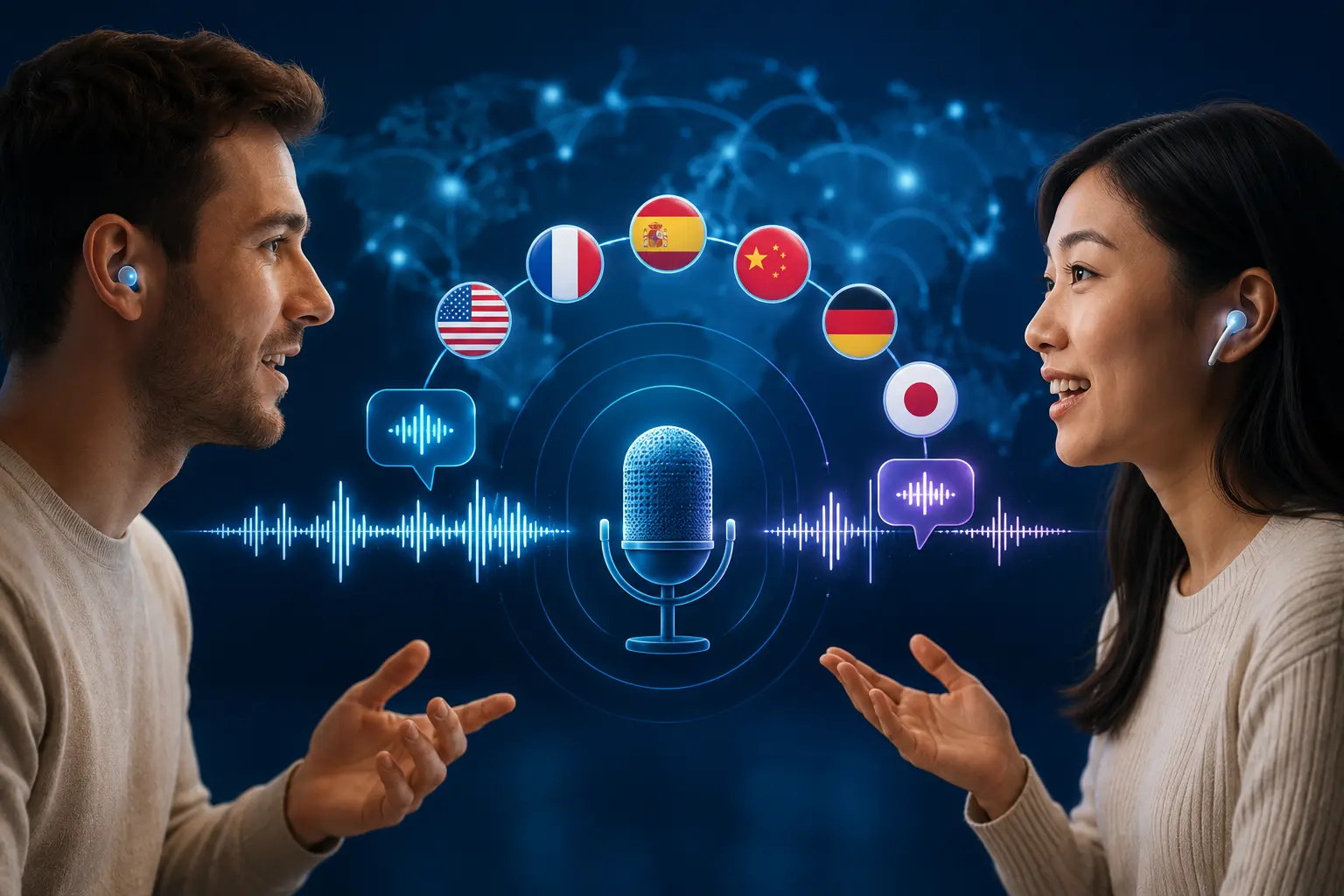
Artificial intelligence has transformed the way people communicate across languages. A modern voice translator can now listen to speech, understand its meaning, translate it into another language, and play the translated voice within seconds.
Instead of relying on interpreters or asking everyone to speak English, people can communicate naturally in their own language during meetings, interviews, customer calls, online classes, and international collaborations.
This guide explains how AI voice translators work, where they are used, how accurate they are, and what features matter when choosing one.
What Is a Voice Translator?
A voice translator is software that converts spoken language into another language using artificial intelligence. Unlike traditional translation apps that only translate text, a voice translator processes live speech, understands context, generates an accurate translation, and delivers it as natural-sounding audio.
Modern AI voice translators combine several technologies into a single process:
Automatic speech recognition (ASR)
Language detection
Neural machine translation
Context-aware AI processing
Text-to-speech synthesis (TTS)
Together, these technologies allow conversations between people who do not share a common language.
Quick Answer
| Question | Answer |
|---|---|
| What is a voice translator? | AI software that translates spoken language into another language. |
| Can it work in real time? | Yes, modern AI systems translate conversations with very low latency. |
| Can everyone speak their own language? | Yes. Each participant can usually continue speaking naturally. |
| Is it useful for business? | Yes. It reduces language barriers in meetings, sales, hiring, and customer support. |
| Does it support many languages? | Most modern platforms support dozens of languages. |
How Does an AI Voice Translator Work?
Real-time voice translation happens through several AI processes that work almost instantly.
Step 1. Speech Recognition
The system listens to the speaker and converts speech into text.
High-quality speech recognition is essential because every translation depends on correctly understanding the original sentence.
Step 2. Language Detection
If necessary, the AI automatically identifies the spoken language.
This makes multilingual meetings much easier because users don't always need to select their language manually.
Step 3. AI Translation
The translated sentence is generated while preserving:
Context
Grammar
Tone
Intent
Meaning
Modern AI models translate ideas rather than individual words, producing much more natural conversations.
Step 4. Natural Voice Generation
The translated text is converted back into realistic speech.
Instead of robotic voices, modern systems generate smooth and natural audio that is easy to understand.
Step 5. Audio Playback
The listener hears the translated speech almost immediately.
The entire process usually takes only a few seconds, allowing conversations to continue naturally.
Where Are Voice Translators Used?
Real-time voice translation has applications across many industries.
| Industry | Example |
|---|---|
| Business | International meetings |
| Sales | Client discovery calls |
| Recruitment | Candidate interviews |
| Healthcare | Doctor-patient communication |
| Education | Online learning |
| Customer Support | Global service teams |
| Tourism | Travel assistance |
| Legal | Cross-border consultations |
| Government | International cooperation |
| Nonprofits | Global humanitarian projects |
Benefits of Real-Time Voice Translation
Organizations increasingly adopt AI voice translation because it improves communication while reducing costs.
Key advantages include:
Faster international meetings
No need for human interpreters
Lower translation costs
More natural conversations
Better customer experience
Increased global collaboration
More hiring opportunities
Better remote teamwork
Easier international expansion
Improved accessibility
Rather than adapting to a shared language, every participant can communicate comfortably in their native language.
Voice Translator vs Text Translator
| Voice Translator | Text Translator |
|---|---|
| Live conversations | Written documents |
| Real-time audio | Manual translation |
| Meetings | Emails |
| Phone calls | Web pages |
| Video conferencing | Documents |
| Natural communication | Reading required |
Voice translators are designed for communication, while text translators are designed for reading and writing.
Voice Translator vs Human Interpreter
| AI Voice Translator | Human Interpreter |
|---|---|
| Available 24/7 | Limited availability |
| Instant access | Scheduling required |
| Lower long-term cost | Higher cost |
| Supports remote meetings | Often requires presence |
| Scales easily | Limited by human availability |
Human interpreters remain valuable for diplomacy, legal proceedings, and highly specialized negotiations, while AI voice translators are increasingly preferred for everyday business communication.
How Accurate Are Modern AI Voice Translators?
Modern AI voice translators are significantly more accurate than earlier generations because they understand sentence context instead of translating words individually.
Translation quality depends on several factors:
Audio quality
Background noise
Speaking speed
Technical terminology
Internet connection
Speaker clarity
Academic research has shown that advances in neural machine translation and large language models have substantially improved translation quality, particularly for conversational speech and multilingual dialogue.
While no translation system is perfect, modern AI can provide highly reliable communication for most professional conversations.
Common Challenges
Even advanced voice translators can encounter difficulties in certain situations.
Common challenges include:
Loud background noise
Multiple people speaking simultaneously
Industry-specific terminology
Strong regional accents
Poor microphone quality
Unstable internet connections
Choosing a platform optimized for real-time communication helps minimize these issues.
Features to Look For in a Voice Translator
Not all voice translators provide the same experience.
Important features include:
Real-time voice translation
Low latency
High speech recognition accuracy
Natural AI voices
Multiple speaker support
Video meeting integration
Screen sharing
Live subtitles
Chat
Secure encrypted communication
Browser compatibility
Mobile support
For business users, meeting management and collaboration tools are often just as important as translation quality.
Why Businesses Are Using Voice Translators
Global companies increasingly work with international customers, distributed teams, and multilingual partners.
Traditional communication methods often require:
Speaking a second language
Hiring interpreters
Sending translated documents afterward
Delaying meetings
AI voice translation removes many of these barriers.
Organizations can communicate more efficiently while allowing employees and customers to speak naturally.
This improves productivity, customer satisfaction, and international collaboration.
Real-World Experience from Voicli
At Voicli, we designed our platform specifically for multilingual video meetings where participants can speak naturally without changing languages.
During product testing, international users from countries including Ukraine, Brazil, Portugal, Italy, Canada, France, the Philippines, and the Democratic Republic of the Congo successfully participated in multilingual conversations while each person continued speaking their native language.
One of the most important observations was that participants quickly stopped thinking about translation technology and focused entirely on the conversation itself. Instead of waiting for an interpreter or reading subtitles continuously, they interacted almost as naturally as if everyone spoke the same language.
Our testing also showed that reducing translation latency has a significant impact on conversation quality. Even small improvements in response time make discussions feel smoother, especially during business meetings where rapid back-and-forth communication is essential.
These practical insights continue to shape the development of Voicli and reinforce our focus on natural, real-time multilingual communication.
Why Voice Translation Is Better Than Subtitles
| Voice Translation | Subtitles |
|---|---|
| Listen naturally | Must constantly read |
| Better eye contact | Eyes stay on text |
| Easier during meetings | More cognitive effort |
| Better accessibility | Depends on reading speed |
| More conversational | Less natural |
Voice translation reduces cognitive load because participants can focus on listening rather than reading.
Supported Languages
Modern AI voice translators typically support dozens of languages.
Voicli currently supports:
Arabic
Chinese
Dutch
English
French
German
Hindi
Indonesian
Italian
Japanese
Korean
Polish
Portuguese
Romanian
Russian
Spanish
Thai
Turkish
Ukrainian
Vietnamese
Popular translation directions include:
English to Spanish voice translator
English to German voice translator
English to French voice translator
English to Japanese voice translator
English to Chinese voice translator
English to Korean voice translator
English to Portuguese voice translator
English to Italian voice translator
English to Arabic voice translator
English to Hindi voice translator
English to Ukrainian voice translator
Spanish to English voice translator
German to English voice translator
Japanese to English voice translator
Chinese to English voice translator
Frequently Asked Questions
What is a voice translator?
A voice translator is AI software that converts spoken language into another language while preserving the meaning of the conversation.
Can AI translate conversations in real time?
Yes. Modern AI systems translate conversations within seconds, making natural multilingual communication possible.
Can two people speak different languages?
Yes. Modern voice translation platforms allow each participant to speak their preferred language while hearing translated speech.
Does voice translation work during video meetings?
Yes. Many modern video meeting platforms now integrate real-time voice translation directly into online meetings.
Is voice translation secure?
Professional platforms typically encrypt audio streams and meeting data to protect user privacy and business communications.
Does it require an internet connection?
Yes. Most AI voice translation systems rely on cloud infrastructure for speech recognition and translation.
Can AI replace human interpreters?
For many everyday business conversations, yes. However, professional interpreters remain important for legal proceedings, diplomacy, and highly specialized negotiations.
Which industries benefit the most?
Business, healthcare, education, customer support, recruitment, tourism, nonprofits, legal services, and international organizations all benefit from real-time voice translation.
Conclusion
Language should never prevent people from sharing ideas, closing deals, hiring talent, or building international relationships.
Modern AI voice translators make multilingual communication faster, more natural, and more accessible than ever before. As speech recognition, translation quality, and voice synthesis continue to improve, real-time voice translation is becoming a standard feature of global collaboration rather than a niche technology.
Whether you're leading an international team, expanding into new markets, or simply connecting with people around the world, a reliable voice translator can remove one of the biggest barriers to effective communication.
About the Author
Ivan Smirnov is an AI Engineer and Co-founder of Voicli with more than five years of experience building scalable AI-powered applications using Python, Django, real-time communication technologies, and multilingual speech systems.
He specializes in backend architecture, low-latency audio processing, AI infrastructure, and real-time voice translation. His work focuses on helping international teams communicate naturally through AI-powered multilingual video meetings, enabling people to speak their own language while collaborating globally.