Voicli Messenger: Real-Time Messaging Without Language Barriers
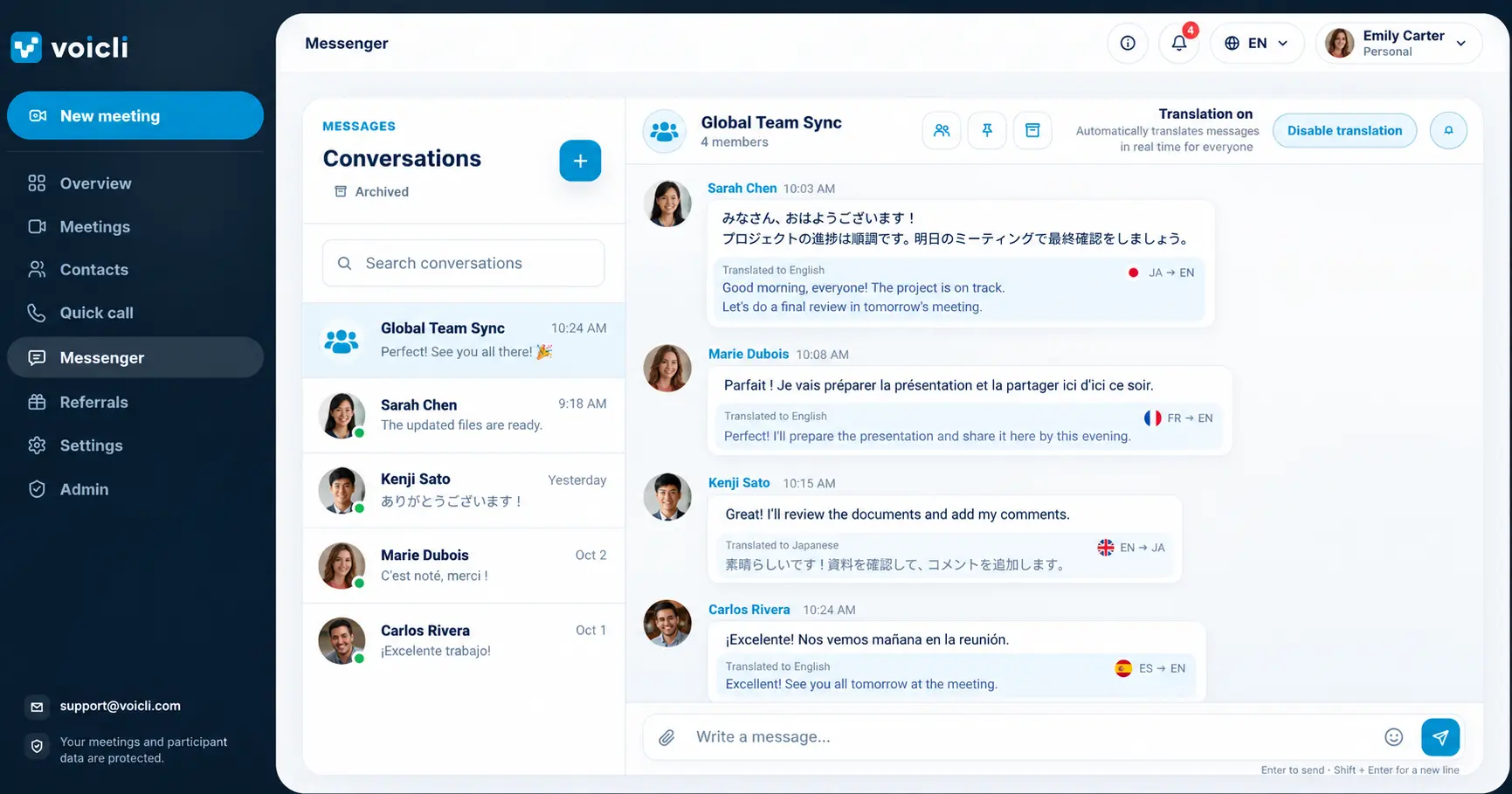
International communication does not happen only during video meetings.
Teams, customers, partners, and communities communicate throughout the day through direct messages, group chats, shared files, images, voice messages, and quick replies. But when participants speak different languages, even a simple chat conversation can become slower and more complicated.
That is why we are introducing Voicli Messenger — a built-in multilingual messenger designed for private and group communication with automatic real-time message translation.
With Voicli Messenger, users can write naturally in their own language while other participants receive the conversation translated according to their selected language.
No constant copying and pasting into external translation tools. No need for everyone in the conversation to switch to English.
Just communicate in the language that feels natural to you.
What Is Voicli Messenger?
Voicli Messenger is an integrated messaging platform inside Voicli that combines modern chat functionality with automatic multilingual translation.
A user can write a message in one language, while another participant can receive it in the language they have selected in Voicli.
For example, one person could write in Ukrainian, another communicate in Japanese, and another prefer English.
Voicli helps make the conversation understandable for each participant without requiring everyone to use the same language.
This becomes even more powerful in multilingual group chats, where several participants may communicate using different languages at the same time.
Instead of forcing an international team to choose one common language, Voicli allows each person to communicate more naturally.
Real-Time Message Translation
Translation is built directly into the messaging experience.
When users send messages, Voicli can automatically translate them for recipients based on their selected language.
This means conversations can continue naturally without interrupting the discussion to translate individual messages manually.
The goal is simple:
You write in your language. Your conversation partner reads the message in theirs.
For international teams, customers, partners, and communities, this can significantly reduce the friction that normally comes with multilingual communication.
Multilingual Group Chats
Language differences become even more challenging when more than two people are involved.
A group might include participants from Germany, Japan, Ukraine, France, Korea, or other countries. Traditionally, everyone would have to communicate using one common language — usually English — even when some participants are far less comfortable using it.
Voicli Messenger is designed differently.
In a group conversation, participants can have different language preferences, while translation adapts the messages for each user.
This makes Voicli particularly useful for:
international teams;
global sales conversations;
multinational projects;
international partnerships;
customer support;
recruitment;
universities and international admissions;
cross-border communities;
organizations working with customers or partners in multiple countries.
The objective is not simply to translate text. It is to make multilingual conversations feel like normal conversations.
More Than a Translation Tool
Voicli Messenger is designed as a complete communication experience rather than a standalone translation window.
It supports both private conversations and group chats, together with the messaging features users expect from a modern messenger.
Users can:
send direct messages;
create group conversations;
reply to specific messages;
edit sent messages;
delete messages;
forward messages;
add reactions;
send files;
share images;
send video and audio;
see online and last-seen status;
see when another participant is typing;
track unread messages;
pin important conversations;
archive chats;
mute conversations.
This allows multilingual communication to remain inside one workflow instead of switching between a messenger, translation application, email, and meeting platform.
Private Messaging Between Confirmed Contacts
Privacy and communication control are important parts of the messenger architecture.
Private conversations in Voicli can only be created between confirmed contacts.
This helps prevent arbitrary users from opening direct conversations with people they have no established connection with and creates a clearer boundary around private communication.
Users can therefore build their contact network first and communicate directly with confirmed connections afterward.
Group Management and Roles
Group communication also requires more than simply adding several people to one chat.
Voicli Messenger includes a role-based group structure with three roles:
Owner, Admin, and Member.
This provides a clear hierarchy for managing group conversations.
Depending on their permissions, group administrators can manage participants and the group itself, while ownership can also be transferred when responsibility for the conversation changes.
This makes group chats suitable not only for informal conversations but also for teams, projects, organizations, and long-running international collaborations.
Built With Security in Mind
Messaging platforms handle private conversations and shared files, so security has been considered at several levels of the Voicli Messenger architecture.
Access to the messenger API is protected through user authentication, helping ensure that protected resources are available only to authorized users.
For real-time communication, Voicli uses WebSocket connections. These connections use short-lived, single-use access tickets rather than relying on long-lived credentials during WebSocket establishment.
The purpose of this approach is to reduce the exposure of reusable authentication credentials when establishing real-time connections.
Secure File Upload Architecture
Files are also handled through a controlled upload process.
Instead of sending large files through the main application API, Voicli can provide temporary upload links that allow files to be uploaded directly to protected storage.
The process is designed so that:
an authorized user requests permission to upload a file;
Voicli provides a temporary upload link;
the file is uploaded directly to protected storage;
the uploaded file is verified before it can be used in a conversation;
access to file downloading is controlled through the backend.
This architecture helps separate file transfer from normal messaging requests while keeping application-level control over how uploaded content is used and accessed.
Messaging and Meetings in One Multilingual Platform
Voicli originally focused on one of the most difficult parts of international communication: real-time spoken conversations across different languages.
Voicli meetings allow participants to speak their own languages while the platform provides near-real-time voice translation and live subtitles.
But business communication does not stop when a meeting ends.
People continue discussing decisions, sending documents, asking questions, sharing updates, and coordinating work through messages.
Voicli Messenger extends the same multilingual philosophy into that part of communication.
A conversation can now continue before, during, and after a meeting without requiring everyone to suddenly switch to another language or another communication platform.
From Multilingual Meetings to Multilingual Communication
Most communication software treats translation as an additional feature.
Voicli is being developed around a different idea:
language should not determine who you can communicate with.
A Japanese customer should be able to communicate comfortably with a Ukrainian company.
A French sales manager should be able to work with a Korean partner.
A multilingual project team should not have to choose which participant must communicate in a foreign language all day.
Voice translation solves part of this problem during calls.
Real-time translated messaging addresses another major part of everyday international communication.
Together, they move Voicli closer to becoming a complete multilingual communication platform.
Why Real-Time Translated Messaging Matters
Language barriers often create problems that are easy to underestimate.
A person may technically understand English but still need significantly more time to formulate a response.
Important details may be simplified because someone cannot express the exact meaning they intended.
Team members may participate less actively because writing in a foreign language requires additional effort.
Potential customers may avoid asking detailed questions.
And informal communication — where relationships between colleagues and partners are often built — can disappear almost completely.
Automatic translation inside the conversation reduces that additional step.
Instead of thinking:
"How should I say this in another language?"
users can focus on:
"What do I actually want to say?"
That difference can make international communication significantly more natural.
One Conversation, Multiple Languages
Traditional messaging assumes that a conversation has one language.
International communication rarely works that way.
Voicli Messenger is designed around the idea that each participant can have their own language.
The sender's language and the recipient's preferred language do not need to be the same.
And in a group, every participant does not need to share a common language either.
This is where multilingual messaging becomes fundamentally different from simply adding a "Translate" button underneath a message.
Translation becomes part of the communication layer itself.
A Natural Extension of Voicli
Voicli's goal has always been to reduce language barriers in real human communication.
With Voicli Messenger, that experience now extends beyond video conversations.
Users can communicate through:
real-time voice conversations;
live translated subtitles;
private multilingual messaging;
translated group conversations;
images and files;
audio and video;
ongoing conversations between meetings.
Instead of treating meetings and messaging as separate experiences, Voicli can connect them around one principle:
everyone should be able to communicate in their own language.
The Future of Multilingual Communication
Global work is becoming increasingly distributed.
A team can have developers in Ukraine, customers in Japan, partners in Germany, suppliers in Korea, and consultants in France.
The technology connecting these people already exists.
The remaining problem is often language.
We believe communication platforms should adapt to their users — not force users to adapt to one language.
Voicli Messenger is another step toward that future.
Write in your language.
Let the other person communicate in theirs.
And keep the conversation moving.