Real-Time Speech Translation: Translation Devices vs Voicli
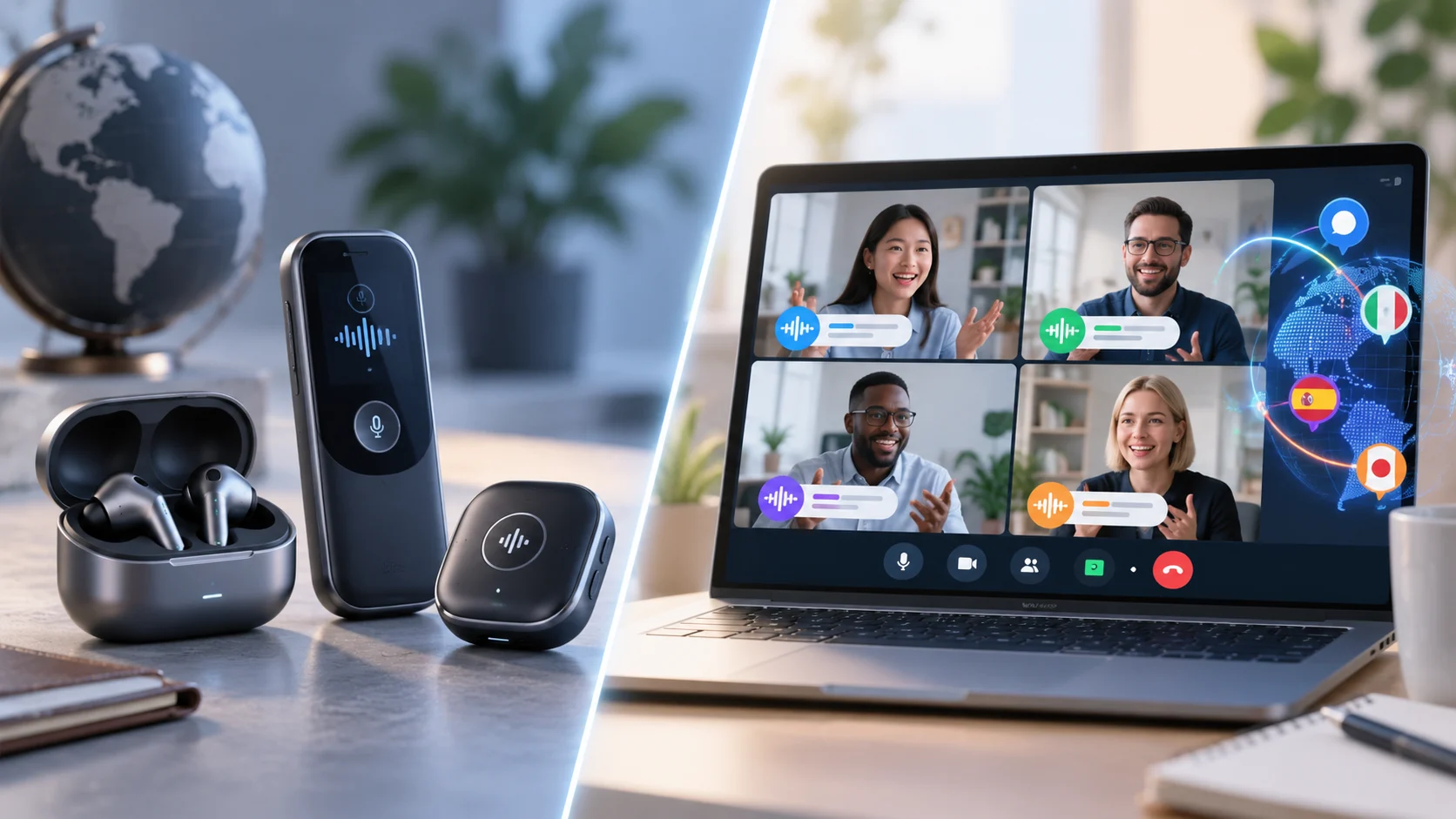
Real-time speech translation is changing the way people communicate across languages.
Instead of typing a sentence into a translator and waiting for the result, modern AI can recognize spoken language, translate its meaning, and deliver the translation as text or spoken audio during a live conversation.
There are now several ways to do this.
You can buy dedicated translator earbuds. You can carry a handheld translation device. You can use a specialized interpreter hub. Or you can use software designed to translate the conversation directly inside an online meeting.
So which approach is better?
The answer depends on where the conversation happens.
Dedicated translation devices can be excellent for travel and face-to-face communication. But for international video meetings, sales calls, interviews, remote teams, and conversations involving several participants, a platform such as Voicli can remove the need for separate translation hardware entirely.
What Is Real-Time Speech Translation?
Real-time speech translation is the process of converting spoken language into another language while a conversation is happening.
A typical AI translation process includes four stages:
Speech → recognition → translation → translated text or voice
Modern systems can perform these steps quickly enough to support live conversations.
This is different from traditional translation software, where someone speaks or types a sentence, waits for a translation, and then passes the result to another person.
With real-time voice translation, the technology becomes part of the conversation itself.
Voicli takes this approach directly inside multilingual online meetings: participants speak naturally, while speech can be translated into subtitles or translated audio for other participants.
What Types of Real-Time Translation Devices Exist?
The translation hardware market has grown significantly.
Today, users can choose between several types of devices.
Translator Earbuds
Translator earbuds are designed primarily for face-to-face conversations.
Two people can wear earbuds or use an earbud together with a smartphone while translation is delivered during the conversation.
One example is Timekettle WT2 Edge/W3.
According to Timekettle, WT2 Edge supports two-way simultaneous interpretation, 43 online languages, offline translation for selected language pairs, and bilingual translation for groups of up to six people.
This can be useful when:
- travelling;
- meeting someone in person;
- living abroad;
- attending a small bilingual meeting;
- having a conversation without constantly looking at a screen.
The trade-off is that translation depends on additional physical hardware and, in many scenarios, a connected smartphone.
Dedicated AI Interpreter Hubs
More advanced hardware can support larger meetings.
The Timekettle X1 AI Interpreter Hub, for example, combines a standalone translation device with earbuds and several communication modes.
The company says the X1 AI Interpreter Hub can support multi-person interpretation, voice calls, presentation translation and conversations involving up to 20 people across five languages in its standard configuration.
Timekettle also offers an X1 Meeting Interpreter Hub aimed specifically at larger multilingual meetings, with support for additional online participants.
This is much closer to a professional meeting solution than a simple travel translator.
But it also introduces something every organization needs to consider:
hardware infrastructure.
Devices must be purchased, charged, distributed, configured and available wherever the meeting takes place.
Handheld Translation Devices
Another category is the handheld translator.
Pocketalk S2, for example, combines voice translation with a touchscreen and camera translation.
Pocketalk currently advertises translation across more than 90 languages on its S2 devices, together with cellular connectivity and camera-based text translation.
This makes devices such as Pocketalk particularly useful for:
travellers, hotels, retail environments, reception desks, restaurants and other face-to-face situations.
But a handheld translator is fundamentally designed around a person using a device.
That is different from a multilingual online meeting where several people need translation simultaneously.
Translation Device vs Real-Time Translation Platform
This is the important distinction.
A translation device tries to add translation to a conversation happening somewhere else.
Voicli puts the conversation and translation inside the same environment.
| Feature | Voicli | Translator Earbuds | Interpreter Hub | Handheld Translator |
|---|---|---|---|---|
| Real-time speech translation | Yes | Yes | Yes | Yes |
| Translated voice | Yes | Yes | Yes | Yes |
| Translated subtitles | Yes | Depends on device | Yes | Usually shown on device |
| Video meeting built in | Yes | No | Depends on system | No |
| Extra translation hardware required | No | Yes | Yes | Yes |
| Designed for remote meetings | Yes | Limited | Some models | No |
| Multiple participants | Yes | Limited by product | Yes | Primarily 1-to-1 |
| Different participant languages | Yes | Depends on device/mode | Yes | Primarily conversation pairs |
| Camera/text translation | No | Usually no | Depends on product | Often yes |
| Useful without internet | No | Some language pairs | Some modes | Depends on product |
| Best use case | Online multilingual communication | Face-to-face conversation | Organized multilingual events/meetings | Travel and in-person communication |
There is therefore no universal winner.
A handheld translator may be more useful while walking through Tokyo.
Translator earbuds may be more comfortable during a face-to-face conversation.
An interpreter hub may make sense for a physical multilingual event.
But if the problem is:
“We have people in different countries who need to talk to each other online,”
dedicated hardware can become unnecessary.
Why Voicli Is Different from Translation Gadgets
Voicli is not a translation gadget.
It is a multilingual meeting platform built around real-time communication.
Instead of buying a device and then using that device alongside a meeting platform, Voicli combines the meeting and translation in the same experience.
No Translation Device to Buy
With hardware translators, someone needs to own the hardware.
If five people need special earbuds, those earbuds need to exist.
If another participant is located thousands of kilometres away, they need compatible equipment or another way to receive the translation.
With Voicli, participants use supported web browsers.
There is no dedicated translator that needs to be shipped to a customer, candidate, partner or colleague before the conversation can happen.
That makes an important difference for international business.
A sales prospect should not need to buy translation earbuds before talking to you.
A candidate should not need a dedicated translator before an interview.
A supplier in another country should not need your company's hardware.
They need a way to join the conversation.
Translation Is Built into the Meeting
Consider a traditional setup:
Video platform + translation device + headphones + translation app
Now compare it with:
Voicli meeting
In Voicli, translation is part of the communication environment itself.
Participants can use Original, Subtitles or Premium real-time translation modes. Premium mode translates spoken language and generates translated speech, while participants can separately control original and translated audio levels.
This reduces the number of tools involved in a multilingual conversation.
Everyone Does Not Need to Speak the Same Language
This becomes even more important when meetings involve more than two people.
Imagine a meeting with participants from Ukraine, Germany, Korea and France.
The traditional solution is often:
Everyone speaks English.
That works when everyone is comfortable speaking English.
But understanding English and being able to negotiate, explain technical details, react quickly or express nuanced ideas in English are very different things.
Real-time speech translation creates another possibility:
everyone speaks the language in which they communicate best.
Voicli can include participants using different languages in the same meeting, with each participant selecting how they want to receive the conversation.
This is fundamentally different from handing one translator device back and forth between two people.
Why This Matters for International Sales
International sales conversations happen quickly.
A customer asks a question.
The salesperson responds.
The customer challenges something.
Someone explains the price.
Another participant joins.
Technical details appear.
A negotiation starts.
Stopping every few sentences to operate a translation device changes the rhythm of that conversation.
With live speech translation built into the meeting, translation can happen as part of the interaction.
This makes Voicli particularly relevant for:
international sales calls, customer conversations, supplier negotiations, partnership discussions and product demonstrations.
Instead of asking:
“Can this prospect speak English?”
companies can start asking:
“Can we communicate effectively regardless of which language the prospect speaks?”
Real-Time Speech Translation for Job Interviews
Recruiting presents a similar problem.
A candidate may understand a foreign language well enough to read a job description or write an email while still finding a live interview significantly more difficult.
Interviews require fast responses.
Candidates need to explain experience, decisions, technical concepts and achievements while reacting immediately to new questions.
Recruiters face the same problem when interviewing candidates from another language market.
With a multilingual meeting platform, both sides can communicate in their preferred languages while translation supports the conversation.
Voicli is designed for multilingual interviews as well as meetings with international clients, partners and teams.
What About Multilingual Team Meetings?
Hardware becomes even less convenient when multilingual conversations happen regularly.
Imagine buying, distributing and maintaining translation devices for a remote team spread across several countries.
Now imagine repeating the process every time a new employee, consultant or customer joins.
Software changes the economics of the problem.
The translation environment can follow the meeting rather than the physical device.
This makes browser-based real-time speech translation particularly suitable for distributed companies where multilingual communication is not a rare event but part of everyday work.
When a Translation Gadget Is Better Than Voicli
There are situations where we would recommend a dedicated translation device instead.
If you are travelling and want to speak with someone beside you, carrying a translator may be extremely convenient.
If your internet connection is unavailable, a device that supports offline translation for your language pair can be useful.
If you need to translate road signs, menus or printed documents, a handheld translator with a camera has an obvious advantage.
And if you are organizing a specialized physical event, dedicated interpretation equipment may also make sense.
Voicli solves a different problem.
Voicli is designed primarily for people who need to communicate with each other remotely across languages.
That is where removing special translation hardware becomes an advantage.
Translation Hardware Solves Access to Translation. Voicli Solves Access to the Conversation.
This may be the biggest difference.
The first generation of electronic translators answered:
“How can I translate what this person just said?”
Modern translator earbuds improved that question:
“How can two people hear translations while talking?”
The next step is broader:
“Why should participants think about the translation system at all?”
For an online meeting, the ideal experience is not necessarily to give everyone another gadget.
It is to make translation an invisible part of communication.
Someone speaks.
Another participant understands.
The conversation continues.
That is the direction real-time speech translation is moving toward.
Which Real-Time Speech Translation Solution Should You Choose?
Choose translator earbuds when your priority is natural face-to-face conversation.
Choose a handheld translator when travelling, working at a physical service desk, or when camera translation is important.
Choose a dedicated interpreter hub when organizing structured in-person multilingual meetings and dedicated hardware fits your workflow.
Choose Voicli when the people who need to communicate are in different locations and you want video meetings, translated subtitles and real-time voice translation inside one platform.
The best translation technology is not necessarily the device with the longest list of languages or the largest number of features.
It is the one that adds the least friction to the conversation you actually need to have.
Frequently Asked Questions About Real-Time Speech TranslationWhat is real-time speech translation?
Real-time speech translation uses AI to recognize spoken language, translate its meaning and deliver the translation while the conversation is happening. The result can be displayed as translated text or generated as translated speech.
What is the difference between speech translation and voice translation?
The terms are often used interchangeably. Speech translation usually describes the complete process of recognizing and translating spoken language, while voice translation often emphasizes delivering the translated result as spoken audio.
Can AI translate speech in real time?
Yes. Modern AI systems can recognize speech, translate it and generate translated text or voice with sufficiently low delay to support live conversations. Some processing delay is still required because the system needs enough context to understand and translate what was said.
What is the best device for real-time language translation?
It depends on the scenario. Translator earbuds can be useful for face-to-face conversations, handheld devices are practical for travel, interpreter hubs can support organized multilingual environments, and software platforms such as Voicli are better suited to remote multilingual meetings.
Are translator earbuds better than translation apps?
Translator earbuds can create a more natural hands-free experience during face-to-face conversations. Software has an advantage when participants are remote because there is no need to provide specialized hardware to every participant.
Do I need translation earbuds for a multilingual video call?
No. A multilingual meeting platform can translate speech directly during an online conversation. Voicli combines video meetings, translated subtitles and real-time voice translation without requiring dedicated translation earbuds.
Can several people use real-time speech translation at the same time?
Yes, depending on the platform or device. Some translation hardware supports groups, while multilingual meeting platforms can provide translation for multiple participants during the same online meeting.
Can people speak different languages in the same meeting?
Yes. In Voicli, meeting participants can use different languages and receive the conversation according to their selected language and translation mode.
Does real-time speech translation work without the internet?
Some dedicated translation devices support selected offline language pairs. Full cloud-based AI translation platforms generally require an internet connection. For example, Timekettle offers offline translation for selected languages and modes on some devices.
Is a translation device worth buying?
It can be worth buying if you frequently need translation while travelling or communicating face-to-face. If most of your multilingual conversations happen online, software-based translation may be more practical because participants do not need dedicated hardware.
Can real-time voice translation replace a human interpreter?
For everyday business meetings, interviews, sales conversations and team discussions, AI translation can remove many common language barriers. Human interpreters can still be preferable for legal, medical, diplomatic or other high-stakes situations where specialist judgment and extremely precise interpretation are required.
What is Voicli?
Voicli is a multilingual online meeting platform with real-time AI voice translation and translated subtitles. Participants can speak naturally while other people receive the conversation in a language they understand.
Does Voicli require special hardware?
No dedicated translation device is required. Voicli is browser-based, so participants can join using a supported browser and allow access to their microphone. Headphones are recommended for the best multilingual audio experience but are not always required.
What is the main advantage of Voicli over translation gadgets?
For remote communication, the main advantage is that Voicli combines the conversation and translation in one environment.
There is no separate translator to distribute, no translation gadget that an external participant needs to own, and no need to combine a separate video meeting with a physical translation device.
Participants simply join the multilingual meeting and communicate.
Try Real-Time Speech Translation with Voicli
Language should not determine who you can talk to.
Whether you are meeting an international customer, interviewing a candidate, talking with a supplier or working with a global team, Voicli lets participants communicate across languages inside the same online meeting.
Speak your language.
Let everyone understand.
Try Voicli and experience real-time speech translation directly inside your next multilingual meeting.